
Tuscarawas County Court Calendars Explained
No single Tuscarawas County calendar covers every trial-level setting. Each court keeps its own. Common Pleas General Division ties case information to County eServices and posts a Weekly Motion Docket on the side. New Philadelphia Municipal Court offers a public Record Search with a Calendar Search mode. Southern District Court gives you two routes. One is a Hearing Date search inside its public Docket Search, plus a separate calendar link. Every channel covers only the court that maintains it.
Citations, case entries, and calendar results can all show a date. Their weight differs once something changes. The General Division labels its motion schedule as subject to change. New Philadelphia cautions that its computer display is current only within the system's limits. Read any calendar alongside the current docket. When a hearing is close, confirm with the court office itself.
The official Common Pleas case-information page describes both the case-information link and the weekly motion schedule.
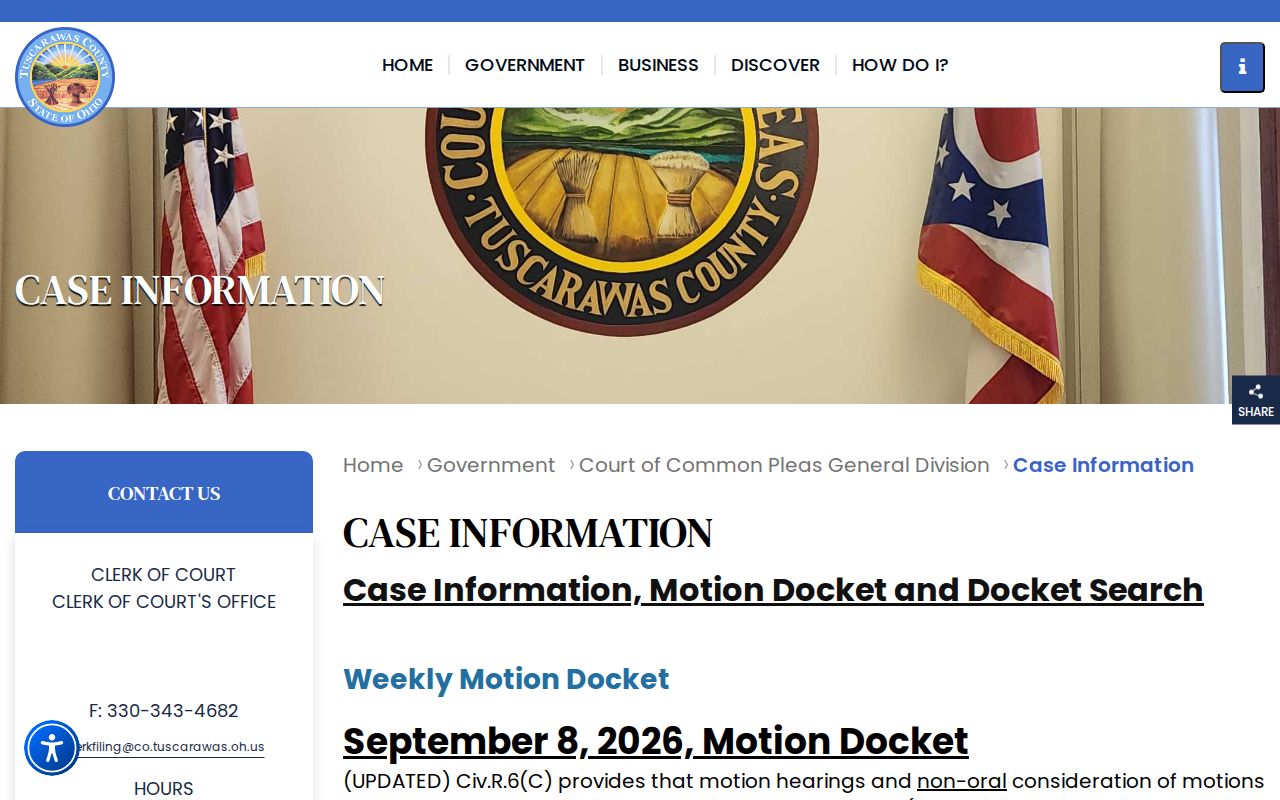
That Motion Docket is one piece of the Common Pleas date-search path. It does not replace the other Tuscarawas County courts' calendars.
Tuscarawas County Court Date Sources
Begin with the court that holds the case. For Common Pleas General Division, search County eServices through the public routes it advertises. Then check the Weekly Motion Docket. Do that if a motion setting is involved. For New Philadelphia, use the Record Search's Calendar Search or its Hearing Date choice. For Southern District, use the Hearing Date form or the calendar. None of these is a statewide Ohio trial-court search. The Ohio Supreme Court docket is no substitute for the local trial docket.
Phones and counters still work well. The Common Pleas Clerk lists 330-365-3243. The General Division's published directory adds court-office contacts for setting questions. New Philadelphia's main number is 330-343-6797, with the Violations Bureau at extensions 203 or 258, Civil and Small Claims at extension 211, and a case-status prompt. Southern District lists 740-922-4795. Staff can point you to the right appearance location. The New Philadelphia Clerk notes it cannot reschedule a matter for the judge's offices.
If a number is unknown, follow the court's name or date path instead of guessing across portals. Locate a related case through the county's Case Lookup first, then check its current setting.
Note: When an online result, a notice, and a calendar disagree, the court office is the fallback. Court-office confirmation is the local fallback.
Finding Your Court Date
Pick the court before you search. For a Common Pleas case, start with current eServices case information. Then call the right court office. The General Division publishes no universal public daily-calendar form. It posts no public reset-request process either. New Philadelphia and Southern District cases get extra date-search fields through their local forms. Trust the latest entry, not the first hearing date in the history.
- Identify whether the case is Common Pleas, New Philadelphia Municipal, Southern District, Probate, or Juvenile.
- Search the court's official case or calendar channel using the case number, name, ticket, or full date only as that form permits.
- Open the current docket information and distinguish a historical setting from the newest dated notice, order, change, or disposition.
- Check the court's calendar or Motion Docket if that court provides one for the event.
- Call the relevant clerk or court office, or visit the counter, when the time or location remains unclear.
The County Clerk's public-record policy allows a targeted request for Common Pleas material when a web result falls short. A request just needs identifying details for the record. No special wording, identity, or explanation of use is required.
Tuscarawas County Motion Docket Dates
The Weekly Motion Docket is a specific scheduling tool for Common Pleas General Division. The court states its convention. Motions and non-oral consideration are generally held on the fourth Monday after filing. Summary-judgment motions generally land on the sixth Monday. The schedule comes out the preceding Monday. The court mails the Motion Schedule to nonlocal counsel and to self-represented people with a pending motion. Treat these as stated conventions, not guarantees of any particular hearing date.
Checking a General Division setting is simple. Match the case number and the newest docket entry to the current weekly schedule. If a setting looks missing or changed, the court directs questions to the appropriate office. Published contacts exist for the administrative judge office, Judge Ryan Styer's office, the magistrate office, the Court Administrator, and the Clerk. The source authorizes no generic online reset procedure, though.
For official court-office and hours context, see the Common Pleas Court Information page.
When the motion schedule shifts and a docket entry needs reconciling, the court-office source supports direct confirmation. Call rather than guess.
How to Read a Court Setting
A court setting is the event the docket schedules. What can a hearing entry carry? The New Philadelphia public record inventory shows: a date, a time, a hearing type, and a courtroom. The same case may also hold distinct filed, status, and disposition dates. Lump them together as one event and you risk missing the current setting.
| Date | The calendar day of a displayed hearing or other setting; compare it with the newest docket entry. |
|---|---|
| Time | The recorded time for the event, which should be confirmed when a schedule has changed. |
| Courtroom | The room or court location shown in the local docket entry when the system provides it. |
| Hearing type | A label such as arraignment, pretrial, review hearing, bench trial, change of plea, or motion setting. |
| Case status | A case-system state distinct from the setting itself; a later disposition can make an earlier date historical. |
Common Pleas labels its published schedule of motions and non-oral consideration the Motion Docket. In New Philadelphia entries, a review hearing sounds minor. It may simply be a later compliance or progress setting. The Southern District traffic page, meanwhile, tags events as arraignment or bench trial. None of these labels tells you how a case turned out. Each one only names a step in the process.
Tuscarawas County Municipal Calendar Search
New Philadelphia Municipal Court's Record Search offers two modes: Case Search and Calendar Search. The public form asks for a Hearing Date through separate month, day, and year selectors. It requires a CAPTCHA response before Begin Search. It also lets you filter by case type. Filters cover Traffic, Criminal, Civil, Small Claims, and Parking. The public source does not pin down the columns a live calendar query returns. Read the result from the form and the current case record. Do not assume a generic layout.
The municipal online payment page notes that court records update every 24 hours. That matters after a recent change, but a payment screen is not a calendar. Search the calendar or case record, then call the court if anything stays unclear. The clerk can tell you where to appear. Scheduling action, though, belongs with the judge's offices.
- Hearing date
- The date field used to locate a calendar event or a scheduled case entry.
- Filed date
- The date a case or paper entered the system, not necessarily a hearing date.
- Review hearing
- A later progress or compliance setting identified in local docket material.
- Disposition date
- The date of a displayed result, which may supersede an earlier scheduled event.
Note: A hearing-date search and a file-date search answer different questions. They are not interchangeable filters.
Continuances, Resets, and Cancellations
A continuance or reset just means a setting moved. Tuscarawas County posts no courtwide online glossary. No single display term covers every moved date. Work chronologically instead: read the old setting, find the latest notice, order, change, or disposition, then confirm through the live calendar or case search. Never assume the first hearing entry is still active after a later docket event.
Two local cautions back this up. The General Division expressly says its weekly motion schedule is subject to change, and New Philadelphia warns that its computer display has system limits. When a setting matters, confirm directly. A missing event can reflect a changed date, the wrong court, an incomplete search field, a disposition, or a restricted record. It is not proof that a case never existed.
Southern District's separate calendar requires a date selection to inspect results. That calendar complements the docket search. It does not merge with the Common Pleas or Municipal systems.
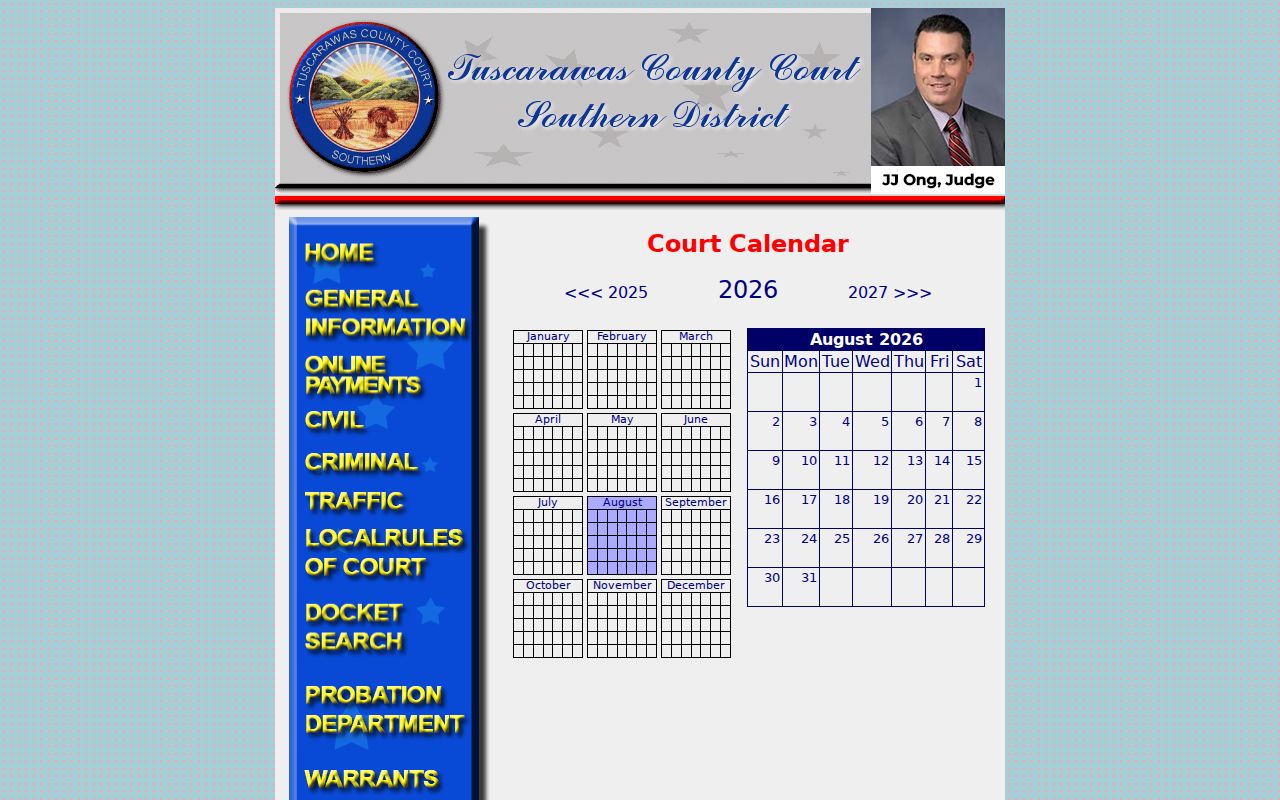
Need to confirm a hearing date in Tuscarawas County? Once the docket system points you to the right case, the Southern District calendar offers a court-specific way to double-check when that hearing is set.
Tuscarawas County Court Date Conflicts
When two dates seem to conflict, read the local docket in chronological order. Separate the older hearing-set entry. Find the newest notice, order, change, or disposition. Then check the court's current calendar or case-search result. The General Division describes its Motion Docket as subject to change, and New Philadelphia cautions that its computer display has system limits. Both local sources back confirmation. Neither supports relying on an older paper or screen alone.
Use the court that controls the case for final confirmation. Common Pleas questions go to the appropriate court office or Clerk. New Philadelphia's clerk can direct a person to the place of appearance. Southern District lists a direct court number. Do not infer a cancellation just because a case result is not immediately visible. An incomplete search result has several causes. A different court, an incomplete field, a moved setting, or a restricted record can all produce one.
Note: The newest dated entry and the court's current confirmation take priority. They outweigh an earlier setting in the docket history.
Tuscarawas County Southern District Dates
Southern District publishes direct date-search instructions that differ from the other local portals. Its Docket Search includes both Hearing Date and File Date. A date search needs all three pieces: month, day, and a four-character year. The same form permits name, case-number, and ticket-number searches. Enter a name as last, first, comma and space included. Use numbers only, with no dashes or letters, for case and ticket fields.
The court also states that Traffic and Criminal Arraignment Court is Tuesday at 1:00 p.m. The exception is a holiday. Contact the court then for a new date. That is a standing schedule with an express exception. It is not a substitute for the individual docket. The public online docket search reaches back to 1994. A result outside that coverage period may need court contact.
Complete-date rule: Southern District instructs users to complete the month, day, and year fields for a hearing-date or file-date search.
If You Miss a Court Setting
Act promptly after a missed Tuscarawas County setting. First, identify the court and the case. Then check the newest docket entry and any current calendar result. Contact the court office or clerk right away for the proper next step and appearance location. The case record and the court's instructions control. The New Philadelphia Clerk's published limits are clear. Clerks do not reschedule matters for the judge's offices.
Missed setting: A missed court date can have case-specific consequences, so obtain current instructions from the court that controls the setting without relying on an old notice.
Use the official local portal and call the court office if the newest date, time, courtroom, or hearing type is not clear.
For a legal decision about a missed setting, consider consulting a licensed attorney; court staff cannot provide legal advice.
A careful confirmation chain is simple. Newest docket entry first, then the current calendar where the court provides one, then the court office. That sequence respects the separate Tuscarawas County systems and avoids treating a static schedule as final.